
 EN
EN



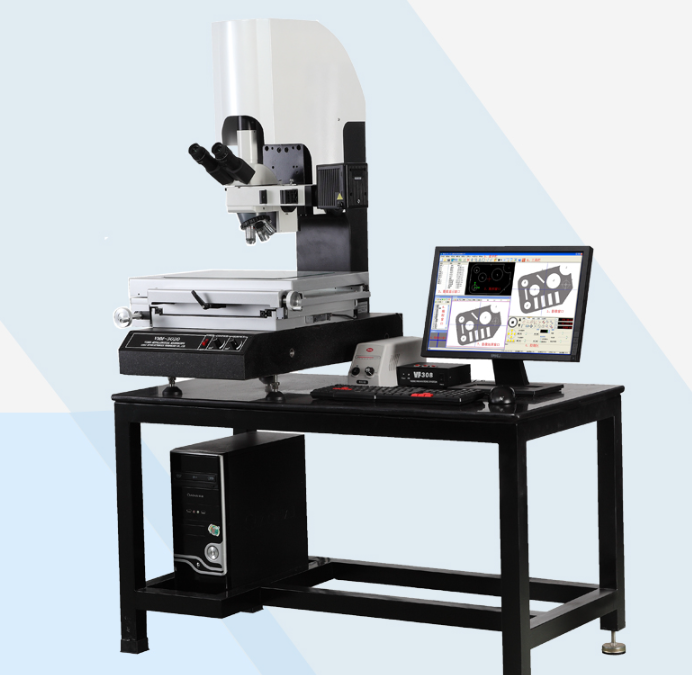
Manufacturing now is very different to what it used to be 20 years ago. It is now rare to spend months producing the same part on a production line. Now there is a constant flow of orders and production is far more diverse. One day, the job may be a batch of precision brackets. The next day, it may be a run of plastic housings and the day after, a set of custom components for a prototype. This constant variety is what is defined as high mix low volume production and it presents a unique set of challenges for quality inspection.
Older traditional measurement tools are built on the concept of repeatability. They are very effective for repetitive tasks, measuring the same thing over and over. But variety is the opposite of repeatability. When each job is different, you need measurement tools that are designed for rapid adaptation and that don’t punish you for switching between different parts. This is where VMM, or video measuring machine, excels.
The measurement problem in high mix environments
Starting with high mix, low volume environments, we see reality on the shop floor. Operators are continually having to change tasks as they attend to different components. Each component has distinct shapes, critical features, and inspection requirements. With manual tools like calipers and micrometers, every new part is a new learning experience. They have to learn where to measure, how to hold the part, and how to document the data. Imagine having to do this for ten, twenty different jobs in a week. It is a big inefficient time pit.
CMMs, or Coordinate Measuring Machines, are incredibly precise, but have their own drawbacks to consideration. Almost every new part will require a special fixture to be constructed to hold the part. Additionally, this will require time for part programming. For small batches of parts, the setup time will most likely exceed the time spent inspecting the part. And with all the different jobs you do throughout the month, this is not a very sustainable method.
In this industry, manufacturers value measuring tools that don't require overhead to be set up. They want to be able to move from one task to another without spending hours setting up jigs, fixturing, and programming. Video measuring machines revolutionize this process.
Wait less, measure more
Measuring Video Machines (VMMs) have a larger advantage over CMMs (Computerized measuring machines) in that they do not require physical fixtures. Traditional touch probe CMMs need to know exactly where the part is in space. That usually means firmly fixing the part or placing it in a custom holder. When working in small production runs, the time spent designing and making that holder could take longer than the inspection process.
VMMs work differently. They use an optical measuring (OM) approach. You simply place the part on the stage. When the camera captures an image of the part, the software immediately detects the position of the part. You do not need to clamp it down or build a custom holder. That's it. You put it down, and measure. This kind of flexibility, to be able to measure parts without the overhead setup, saves a lot of time. In fact, it reduces the bottleneck of inspection and aligns it with the flow of production.
Rapid programming for changing components
An additional challenge for high mix production is programming. For traditional CMMs, programming a measurement routine for a new part is a bit of an art. You must set the coordinate system, dictate the probing locations, and define the measurement routines. For a part to be manufactured ten times, programming it seems an over the effort.
Video measuring machines eliminate this effort. Their software is built to be user friendly. Users can build measuring routines in a small number of clicks over the features. The soft-ware also comes with auto measurement for basic geometry shapes, which means a new part with complex geometry can be inspected quickly without manual programming effort. The soft-ware user focuses on measurement and not on programming the software.
Dealing with a variety of part sizes
In high mix manufacturing, it is difficult to predict the next part to be produced. It can be a small part, for example, a connector that can be held between the fingers, or it can be a large part, for example, a housing that is several inches long. A good measuring tool is able to cope with both extremes and remain accurate.
Video measuring machines have been designed with this flexibility in mind. They offer stages to fit all sizes. Their zoom optical system allows one to see the details clearly as well as large features. Some even have a dual magnification system with wide and high resolution in one configuration. This means that one does not have to have separate machines for small and large parts, one VMM does it all. For a shop with a lot of variety, this is a practical benefit.
Reliable precision without the need for constant recalibration
Regardless of the measuring tool used and the measuring technique, the importance of accuracy is paramount. In high mix environments, the parts to be measured can be composed of different and varying materials, for example, metal, plastic, and rubber. Each of these materials has a unique interaction with measurement tools. Touch probes can deform materials that are rubber, while manual measurement is influenced by the level of skill and fatigue of the operator.
Measuring by Magnification doesn't touch the component either, measuring instead using light and high resolution cameras. That means consistent results, be it hardened steel or soft plastic. No probe deflection, no deflection, and no operator variation. Once the machine is calibrated, it maintains that accuracy, as the variation produced by soft or hard parts is virtually eliminated. That consistency is vital when you're producing for the demanding industries like aerospace, automotive, or medical devices. It builds confidence in your quality data.
Shop floor, measuring by magnification, practical examples.
The value is not just theoretical, it is practical as well, in the hands of the users. One customer stated that it changed their quality control machine. They said that it helped cut inspection time by 40 percent, and the precision is still high. Another customer said that the machine does well both small components and big workpieces, with no compromise in accuracy. That high mix capability is just what they are looking for.
Shop owners will tell you that time is the most critical resource in their business. Anything that minimizes setup time, makes programming simple, and provides consistent and reliable results is invaluable. This is the main reason that shop owners are shifting toward video measurement technology.
Designed for versatility.
Flexibility is fundamental to video measurement technologies, and that’s what makes them so useful. Their design means that you won’t have to run a million iterations of the same sample. You won’t have to spend unnecessary time programming, and you won’t have to custom-build jigs for every task. You will be able to place the sample, take the measurement, and then move on to the next sample. This deceptive simplicity is a result of advanced optical engineering and intelligent software that will take on most of the tedious tasks.
Flexibility for companies that manufacture in high-mix low-volume production is not a nice-to-have. It is a fundamental requirement. It enables them to accept a broader range of work, respond to shifting customer demand, and maintain consistent quality.
Conclusion
The trend toward high mix low volume production is not going away. In fact, it is becoming the standard for manufacturing. Shops that thrive in this environment are those that invest in adaptable solutions. A video measuring machine is a prime example. It removes the need for time-consuming fixturing. It is easy to program. It accommodates all sizes of parts. Finally, it is reliable. It provides the same level of accuracy on different materials, even on parts of varying geometries.
For modern manufacturing operations, the functionality of the VMM is far beyond a measuring tool. It is a flexible system that protects your standard of quality, and allows you to seamlessly transition between jobs. For these reasons it is highly advocated for high mix low volume jobs.
Table of Contents
- The measurement problem in high mix environments
- Wait less, measure more
- Rapid programming for changing components
- Dealing with a variety of part sizes
- Reliable precision without the need for constant recalibration
- Shop floor, measuring by magnification, practical examples.
- Designed for versatility.
- Conclusion