
 EN
EN



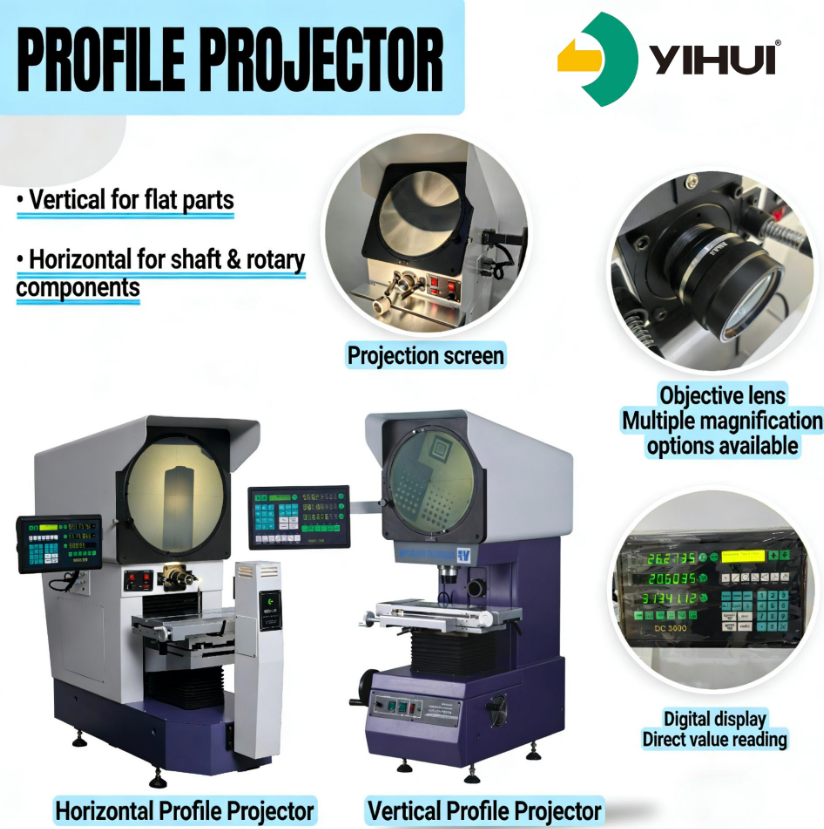
Have you ever tried lining up a small part on a projection screen with a plastic overlay? You squint, you adjust, you move the stage a tiny bit, and then you still are not completely sure. Even when you feel 100 percent confident that the edge is aligned, there is always that nagging doubt. Traditional optical comparators rely heavily on user judgment. Digital readout technology makes this whole process much less frustrating.
Reading Numbers Instead of Guessing Lines
Let me walk you through a typical inspection. You have a machined part with a critical dimension that needs to be within a few thousandths of an inch. On a traditional optical comparator, you project the part silhouette onto a glass screen. Then you line up the crosshairs with the edge of the part image. Then you try to read the dimension off a mechanical scale or a dial indicator. In theory, it sounds simple. In practice, there is always room for error.
Your eye has to decide exactly where the edge is. But edges can be fuzzy, especially if the part has a slight burr or the lighting is not perfect. Then you have to read a scale. On a mechanical scale, you have to guess between the tick marks. If the tick marks are every 0.001 inches, you have to estimate where the measurement falls in between. That guesswork introduces error. Every single time.
A digital readout changes that completely. Instead of watching a needle point to a spot between two lines, you get a direct numerical value on a screen. No guessing. No estimating. Just a clear number. A digital readout on an optical comparator can provide resolution down to 0.5 micrometers. You no longer have to worry about where the needle is pointing. You just read the number and move on.
No More Parallax Problems
Parallax error is one of the most frustrating things about mechanical scales. It is the shift you see when you look at a scale from an angle instead of straight on. If your eye is not perfectly aligned with the measurement mark, the reading changes. On a mechanical scale, this is a constant battle. You have to position your head just right for every measurement. Even a tiny movement of your head, maybe a millimeter or two, can throw off the reading entirely.
Digital readouts eliminate parallax completely. The measurement is captured electronically. There is no scale for you to look at. No dial to align your eye with. The sensor does all the work. It detects the position of the stage and sends that information to a digital display. You can stand anywhere. You can look at the screen from any angle, even from across the room. The number does not change. That consistency alone improves accuracy significantly. For shops that manufacture the same parts day after day, there is no more arguing over who read the scale correctly.
These digital systems also help maintain the same standards across different shifts. They can show deviations from the specifications and provide feedback automatically. That kind of control is great for keeping quality consistent no matter who is running the machine.
Better Resolution Means Better Control
Resolution matters. A lot. On a mechanical scale, you are limited by how finely the scale is marked. Most mechanical systems allow readings to about 0.0005 inches or 0.01 millimeters. But there can still be large variances.
Digital readouts give you much finer resolution. Many systems offer resolutions of 0.5 micrometers or even finer. That is about 0.00002 inches, which is roughly one fifth the thickness of a human hair. Being able to measure at that level means you can identify problems that a typical analog system would miss. If a machine is starting to drift out of tolerance, you will see it in the numbers before the parts become scrap.
Higher resolution also gives you confidence. If your specification is plus or minus 0.01 millimeters, your measurement system should be accurate to at least 0.001 millimeters, which is 1 micrometer. A digital readout provides that level of accuracy. A mechanical scale does not. This is especially true for industries like aerospace, automotive, and biomedical instrumentation, where every micron counts.
Automating Repetitive Tasks
Another benefit of digital readouts is how they handle repetitive measurements. On a traditional optical comparator, every measurement is manual. You move the stage, you read the scale, you write down the number. If a part has the same feature that needs to be measured fifty times, you do that fifty times. By the time you get to the last measurement, your eyes are tired and your patience is thin. The operator is bound to make more and more errors as the task becomes tedious.
With a digital readout system, you can set up measurement routines. You tell the system what to measure and in what order. Then you simply move the stage to each feature, and the system records the data automatically. Some systems can even compare the measurements directly to the nominal values and tell you in real time whether the part is within the acceptable range.
This level of automation saves time, but more importantly, it maintains accuracy by removing operator fatigue from the equation. The system does not get tired. It does not rush through the last few measurements because lunch is almost here. It just does its job consistently. Manufacturers using digital optical comparators have reported reducing first article inspection time from up to 1.5 hours down to only 10 or 12 minutes. That speed, combined with the consistency of digital readouts, means you can inspect more parts more thoroughly without adding extra people.
Immediate Feedback for Real Time Adjustments
One of the best features of a digital readout is how immediate it is. You move the stage, and the numbers change instantly. That gives you real time feedback. If you are trying to center a feature or align a part, you can watch the numbers as you move. You know exactly when you hit the target. No more overshooting and having to come back. No more guessing how much to turn the handwheel.
This immediate feedback loop improves accuracy because it reduces back and forth adjustments. You get it right the first time more often. For complex setups where you have to align multiple features, the digital readout makes the whole process faster and more precise.
Some advanced optical comparators integrate the digital readout with a camera image on a computer screen. You can see the part image and the measurement data in the same place. You can even overlay CAD data onto the part image for direct comparison. YIHUI provides this kind of integrated system. Their equipment is designed to help manufacturers measure with confidence and catch defects early.
Making Data Useful
Here is something that does not get enough attention. A measurement that you do not document might as well not have happened. On a conventional optical comparator, recording data is a manual process. You read the scale, you write the number on a piece of paper, and later someone types it into a computer. Each step in that chain is an opportunity for error. You might misread the scale. You might write down the wrong number. You might make a typing mistake.
A digital readout solves this by capturing data electronically. Many systems have RS232 interfaces or USB ports that let you send measurements directly to a computer or printer. You can log data automatically, generate reports, and feed measurements into statistical process control software. The data is accurate because it came straight from the sensor. No transcription errors. No lost paperwork.
For manufacturers who need to comply with quality regulations or provide traceability, this is a huge advantage. You have a digital record of every measurement. You can review and demonstrate that your parts met the specifications. That kind of documentation builds customer confidence and protects your brand.
The Bottom Line
Digital readout technology makes an optical comparator more accurate in several key ways. It gives you direct numerical readings, so guesswork is gone. It eliminates parallax error because there is no scale to view from an angle. It provides higher resolution, so you can measure tighter tolerances. It enables automation, which reduces operator fatigue and variability. It offers real time feedback for faster, more precise setups. And it captures data electronically, so you can track and prove your quality.
YIHUI has been producing precision measurement instruments since 2003, including optical comparators and video measuring systems for industries like machinery, electronics, aerospace, and automotive. Their comparators come with digital readout systems that help manufacturers improve accuracy and maintain consistent quality across every part they inspect. At the end of the day, an optical comparator is only as good as its measurement system. Adding a digital readout takes a good tool and makes it great.